DISCOVER PROJECT
Technology Services
Anonymous/NDA
Global Onboarding Strategy
When leadership believed their onboarding "worked fine" — and rising turnover said otherwise — I was brought in to close the gap between what leadership assumed was happening and what new hires were actually experiencing.
SERVICES
Workshop Facilitator, Performance Consultant, Stakeholder Management, Learning Experience Mapping
Category
LXD Consulting & Advisory
Duration
2 months
Year
2025
The Challenge
Historically, onboarding had been a founder-led, informal process grounded in deep personal relationships and tribal knowledge. However, this approach was no longer sustainable or scalable. I was brought in as a strategic advisor to help the company reimagine onboarding from the ground up.
Surface what leadership couldn't see from the inside, align a skeptical executive team around a shared definition of success, and design a scalable onboarding structure that worked for people — not just the org chart.
Despite genuine care for people, EcoTech's onboarding had fractured under the weight of rapid growth. It was founder-dependent, inconsistent across departments, and increasingly ineffective for a global workforce that couldn't rely on proximity and tribal knowledge. The harder problem: senior leaders believed the current program was good enough. Meanwhile, new hires were struggling to ramp up, turnover was climbing, and no one owned the end-to-end experience. Leadership wanted autonomy fast — but had built a process that made that nearly impossible.
My Approach
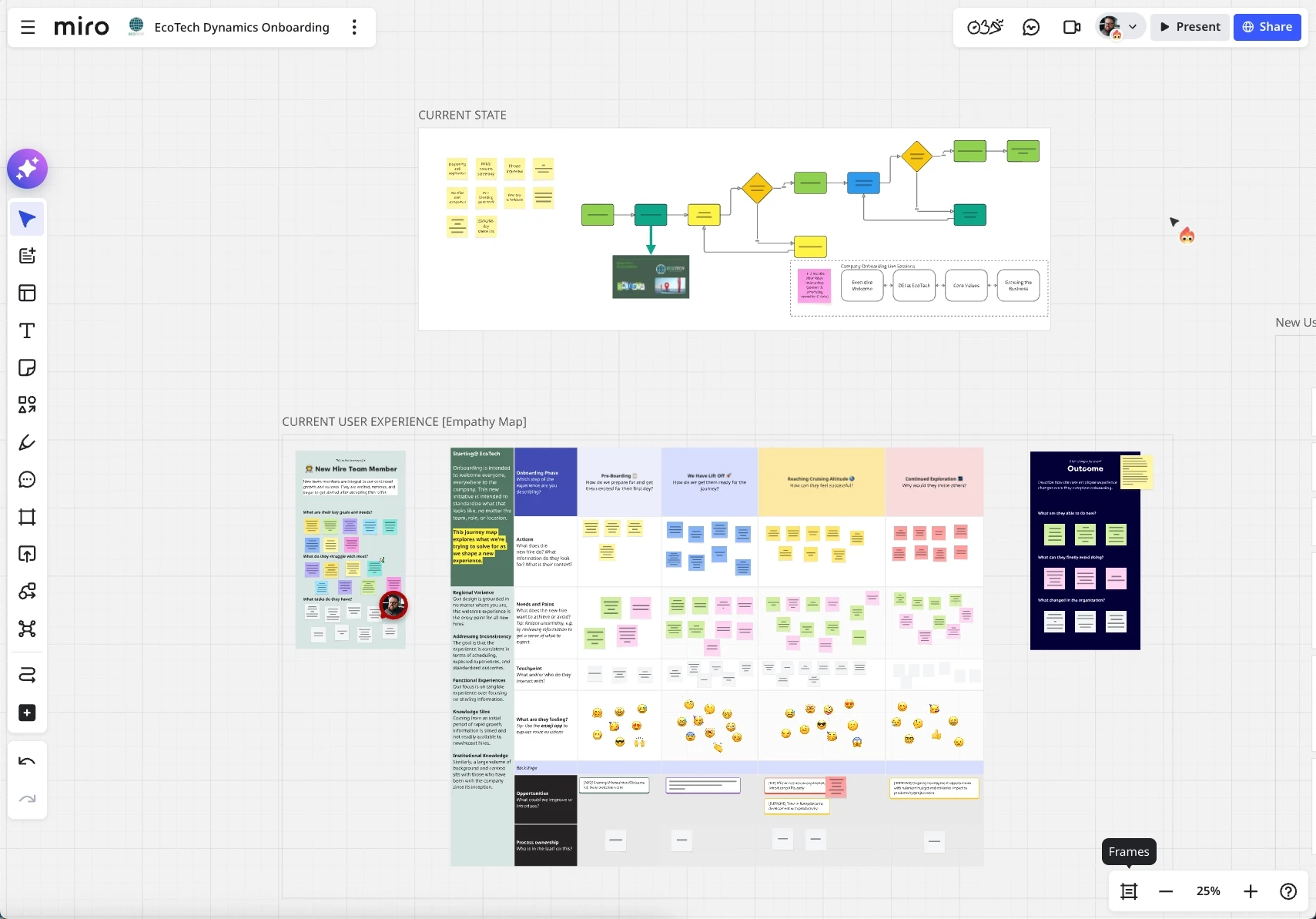
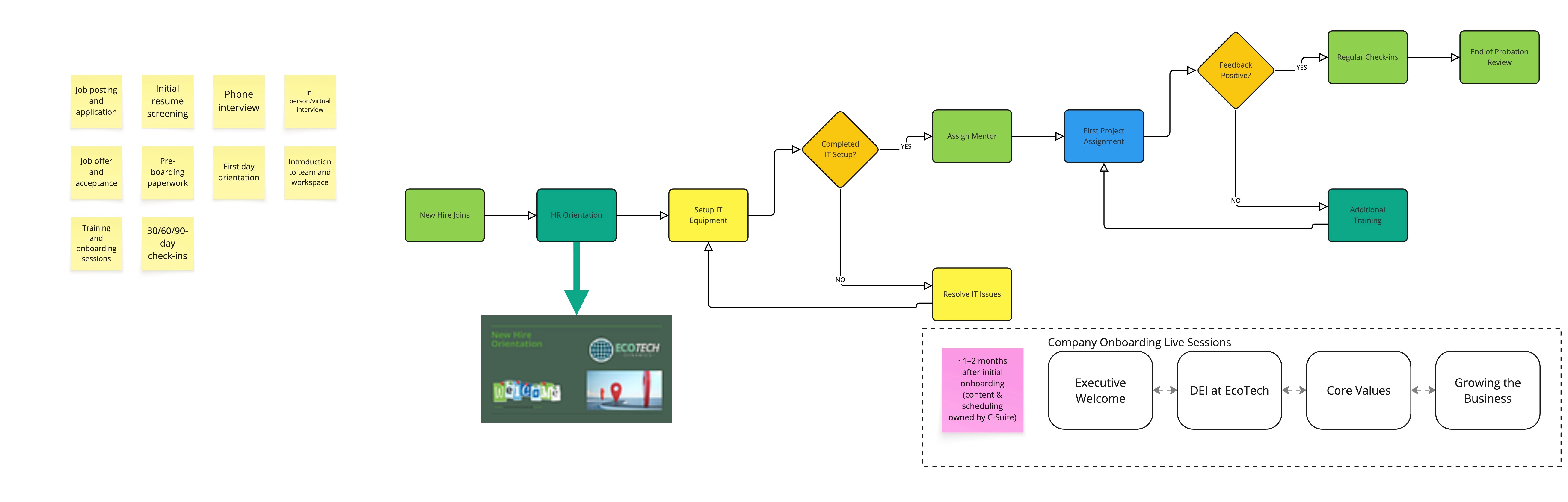
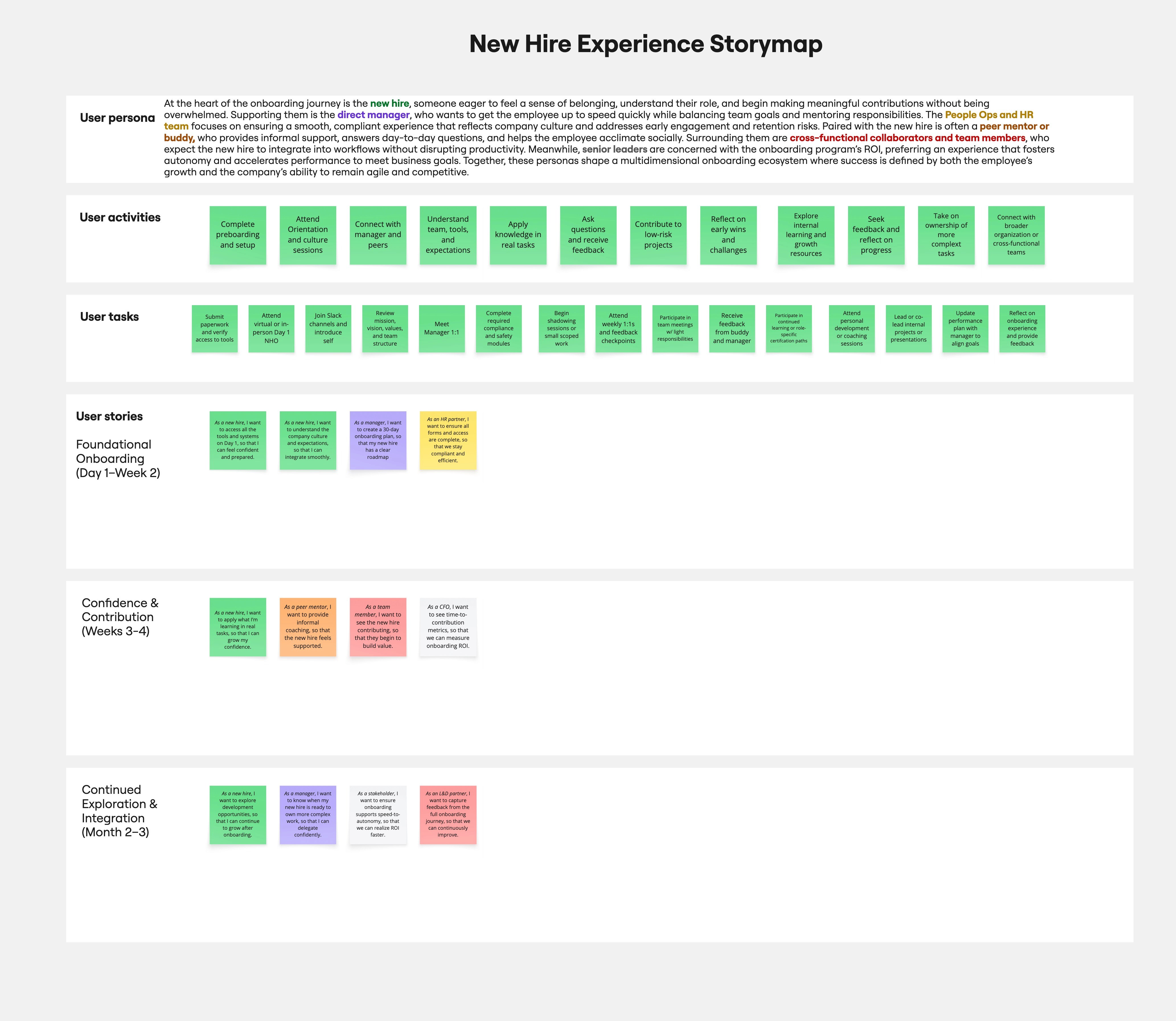
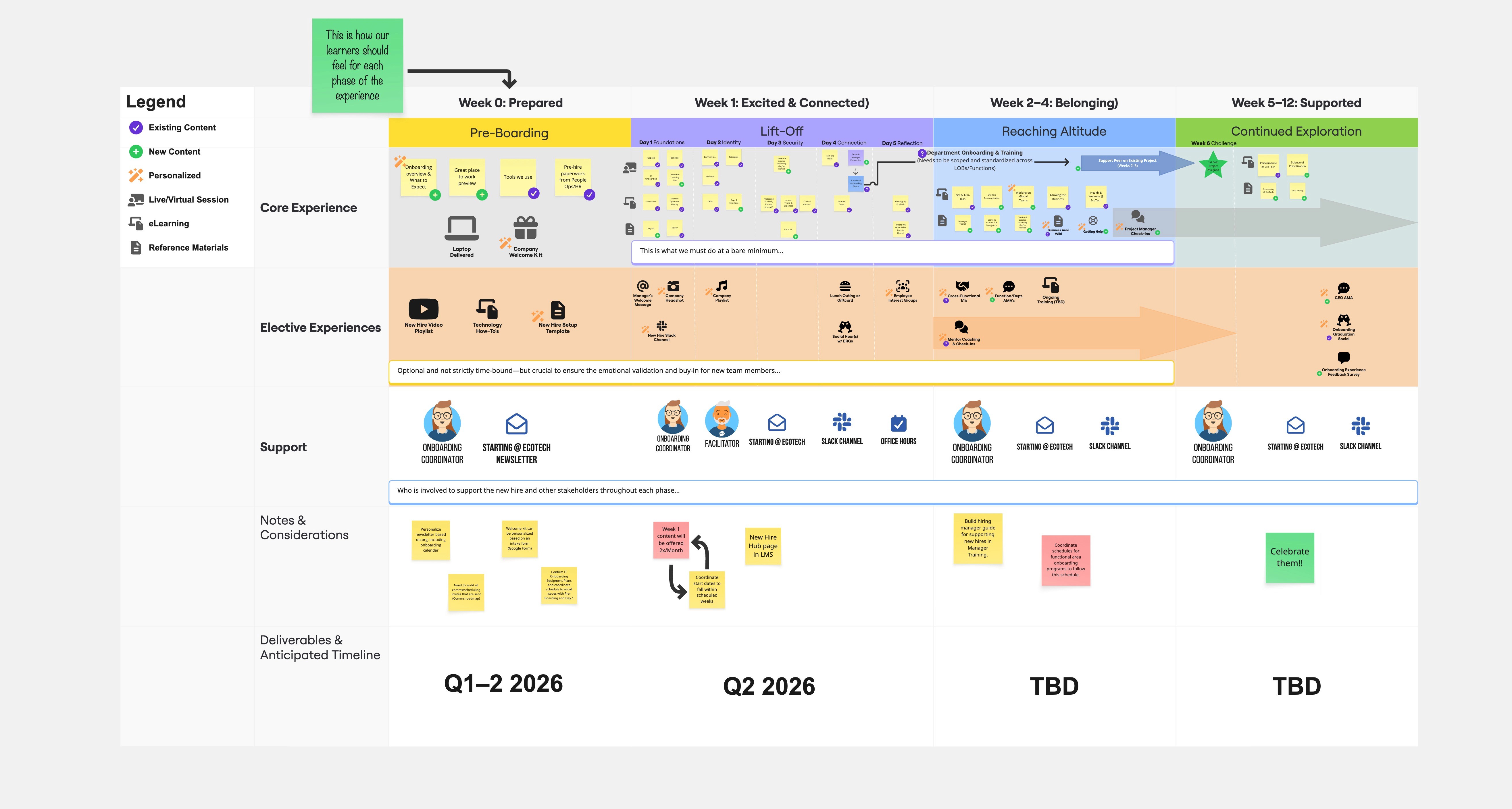
We used Miro to map out the current onboarding process and the separate onboarding program that would happen 1–2 months after the start date.
Rather than designing a "learning experience" in the traditional sense, my role focused on uncovering new hire needs, aligning leadership, and proposing a phased onboarding structure that could scale globally without losing the company’s culture. To that end, I facilitated a series of cross-functional design workshops involving HR, department leads, middle managers, and executive stakeholders.
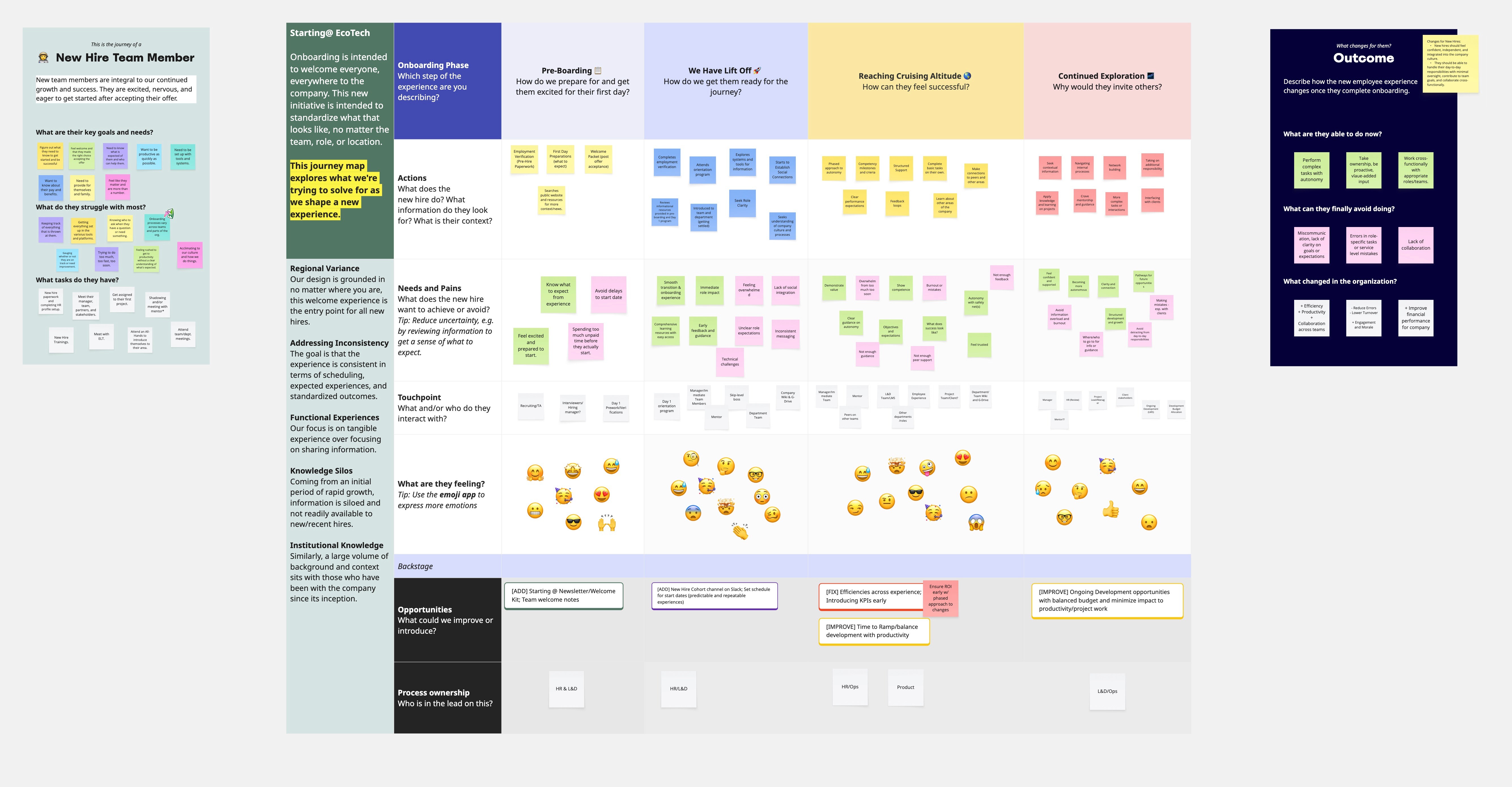
The first move wasn't designing anything — it was listening. I facilitated a series of cross-functional workshops with HR, department leads, managers, and executives to surface what each group believed onboarding was supposed to accomplish, and where reality fell short. Starting from the new hire's perspective, we used empathy and journey mapping to make the experience visible in a way leadership had never seen it — laid out end-to-end, with every gap, assumption, and missed moment accounted for. That visibility did more to shift the conversation than any recommendation could have.
What We Built
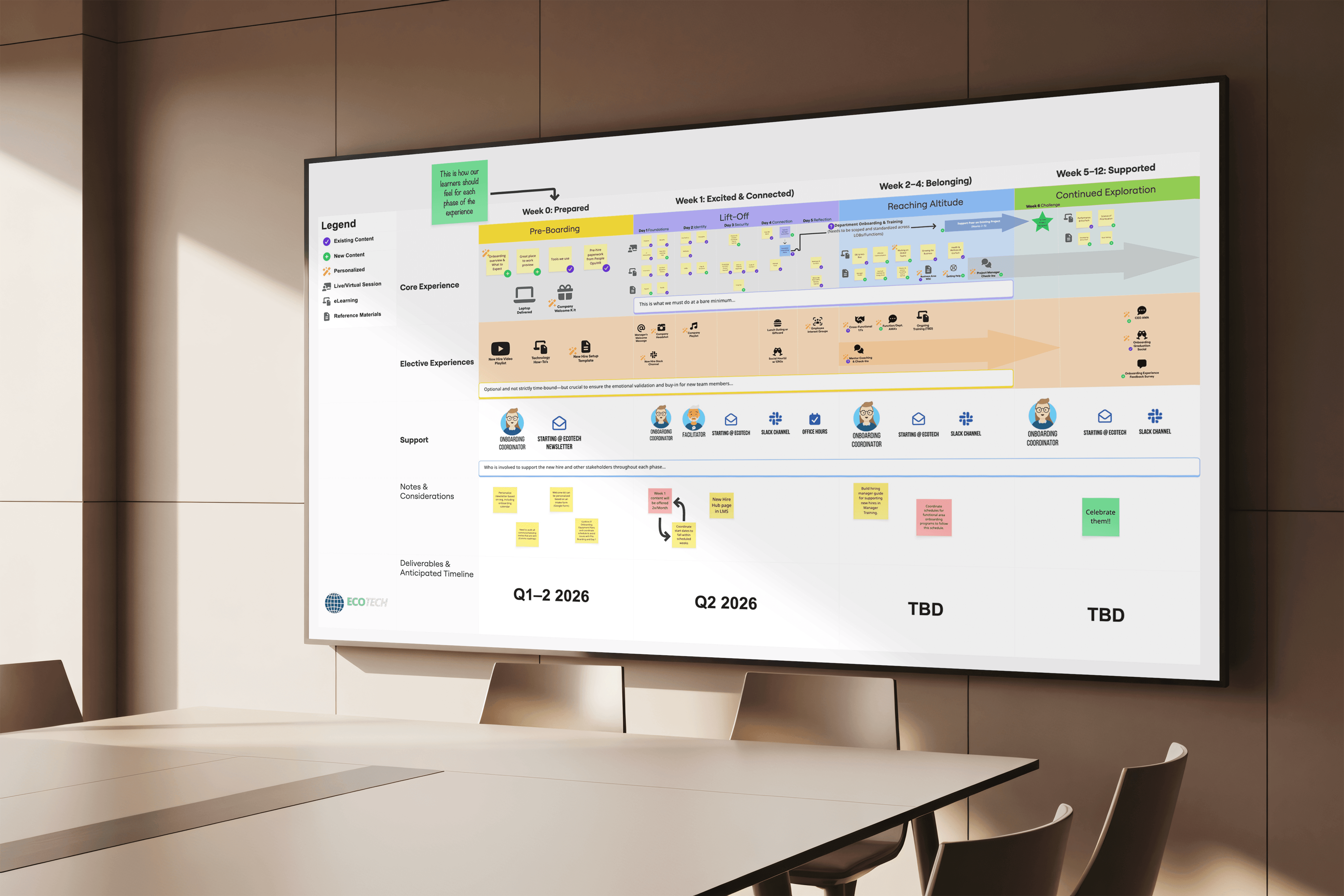
A phased 90-day onboarding journey built around the new hire's actual experience — not the org chart's convenience — with clear ownership, structured touchpoints, and room for the culture to come through at every stage.
Key features
The design work surfaced something more important than process gaps: it revealed that each stakeholder group had a fundamentally different mental model of what onboarding was for. Founders saw it as culture transmission. Managers saw it as productivity ramp. HR saw it as retention insurance. None of them were wrong — but no one had ever put those models in the same room before. The four-phase structure gave each group what they needed without forcing a single frame on the experience. Pre-boarding handled logistics and expectations before day one. Lift Off focused on belonging and orientation in week one. Reaching Altitude built context and capability through weeks two to four. Continued Exploration handed ownership to the new hire by months two and three. The framework wasn't just a deliverable — it was a shared language the team didn't have before.
Inside the Experience
Impact Overview
"We thought we had a decent onboarding process, but going through this experience really helped us see the gaps we were too close to notice. Mike didn’t just give us a plan—he gave us clarity. The experience map helped our entire team get on the same page, and for the first time, I feel confident that we’re building something scalable that actually works for our people, not just the business.”
—People & Culture Leader, EcoTech Dynamics
We aligned on what success would look like. For the new hire: faster ramp-up, reduced confusion, a sense of belonging, and fewer avoidable mistakes. For the business: improved retention, time-to-productivity, and leadership confidence in scaling.
Making the full onboarding experience visible — in one place, from the new hire's perspective — shifted everything. What began as a conversation about checklists became a reckoning with what the company actually owed its people in the first 90 days. Leadership aligned. HR gained the momentum and cross-functional support to begin making critical changes immediately. The full phased strategy moves to funded implementation in the next planning cycle.
“The moment we visualized the full experience, the tone shifted. What started as a conversation about checklists turned into something deeper. Senior leaders weren’t just worried about process—they were worried about losing what made the company feel like them. That clarity helped us move from defensiveness to shared purpose. In the end, they didn’t just agree to the change—they saw themselves in it.”
— M. Jones